By the Estimate Templates editorial team · Last updated · Formulas checked against worked examples
What to include in a general contractor estimate
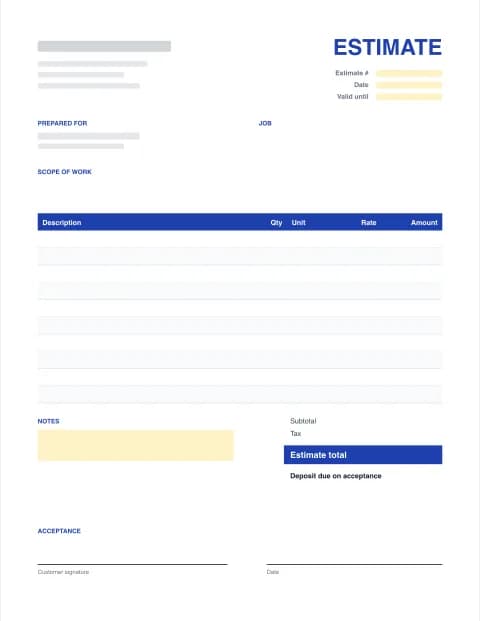
Our contractor estimate template covers the basics every estimate needs (your details, the customer, job site, line items, totals, validity date and signature) plus the details customers in general contractor look for:
- Your contractor license number, if your state requires it on bids and contracts
- Job site address and a short job name the customer will recognize
- Scope of work in plain language, plus clear exclusions
- Labor and materials as separate lines so the customer sees where the money goes
- Permits and inspection fees shown at cost
- Deposit amount, payment schedule and how change orders are handled
- A valid-until date (materials prices move) and a signature line for acceptance
Sample general contractor estimate
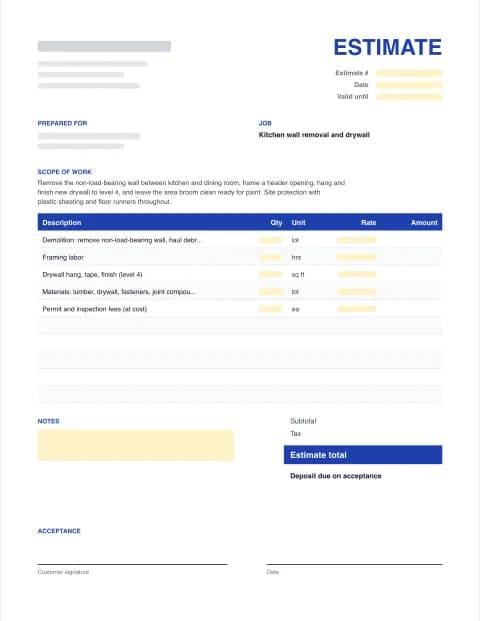
Job: Kitchen wall removal and drywall. Remove the non-load-bearing wall between kitchen and dining room, frame a header opening, hang and finish new drywall to level 4, and leave the area broom clean ready for paint. Site protection with plastic sheeting and floor runners throughout.
| Line item | Qty | Rate | Amount |
|---|---|---|---|
| Demolition: remove non-load-bearing wall, haul debris | 1 lot | $1,200.00 | $1,200.00 |
| Framing labor | 24 hrs | $75.00 | $1,800.00 |
| Drywall hang, tape, finish (level 4) | 380 sq ft | $3.10 | $1,178.00 |
| Materials: lumber, drywall, fasteners, joint compound | 1 lot | $980.00 | $980.00 |
| Permit and inspection fees (at cost) | 1 ea | $350.00 | $350.00 |
| Paint repaired walls, 2 coats (optional) | 1 lot | $650.00 | $650.00 |
| Estimate total (optional items not included) | $5,508.00 | ||
Example prices are for illustration only and are not price guidance; costs vary widely by region, materials and job. Exclusions in this sample: Electrical or plumbing relocation inside the wall, structural engineering, painting (offered as an option), flooring repair under the old wall line.
General contractor estimating tips
Price materials at cost plus a stated markup, or fold your markup into the line price. Either works, but be consistent: customers compare line items between bids, and a surprise markup line erodes trust.
Remember that markup and margin are different numbers. A 25% markup on $1,000 of cost gives a $1,250 price, which is only a 20% margin. If you need a 25% margin, divide cost by 0.75 ($1,333).
Check your state's deposit rules before you ask for money up front. California, for example, limits the down payment on a home improvement contract to $1,000 or 10% of the contract price, whichever is less (Business and Professions Code section 7159.5). Other states set their own limits, so check yours.
Once the customer accepts, bill the job with a matching invoice from Excel Invoice Maker, or convert the estimate in one click with Estimate Pro.
This template is a general business document, not legal advice. Licensing, contract and deposit rules vary by state; check what applies to your trade.